
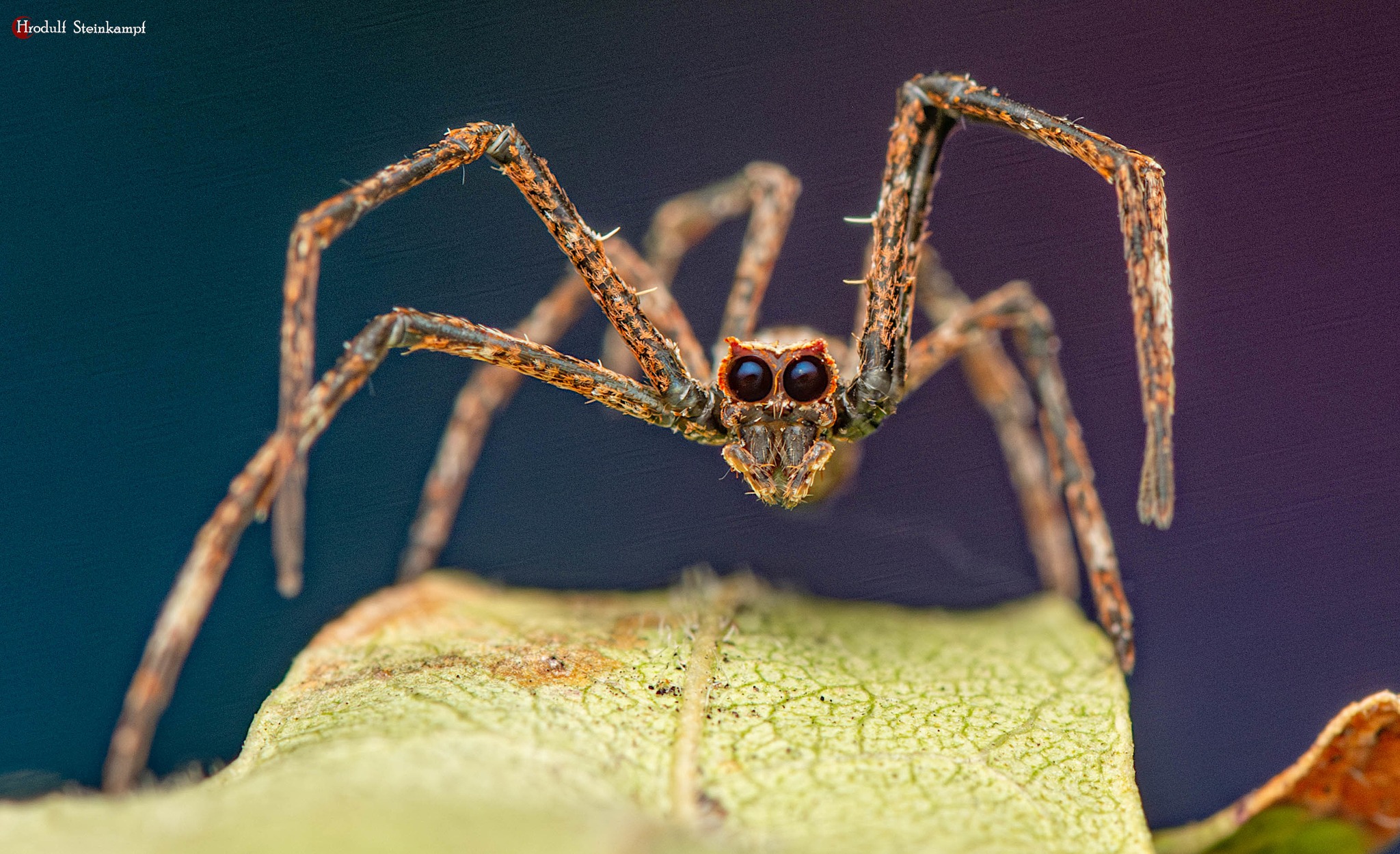
The June Spider of the Month (SOTM) is this juvenile ogre-faced net-casting spider (Asianopis sp.; Deinopidae), photographed by Rudi Steenkamp (me). The spider was found at the Treasure Beach Education Centre in Durban during the University of the Free State’s Zoology/Entomology excursion to KwaZulu-Natal.
Since I wasn’t the one who found the spider, I can’t say much about the find. I have always wanted to photograph an adult Asianopis, but this one was very tiny (3-4 mm, legs excluded). I was still happy when I saw those big eyes through my macro lens. This is only the second time I’ve photographed one, and unfortunately, both were juveniles (this one much smaller than the previous one).
These spiders have the largest simple eyes of any arthropod. Their eyes are incredibly sensitive to light – so much so that the light-detecting membrane inside them is destroyed at sunrise and regenerates each night.
Their eyes are estimated to have an aperture of around f/0.58, which photographers will know is astonishingly bright. For comparison, an owl’s eyes are about f/1.1, meaning these spiders’ night vision is twice as good as that of owls. It is quite apt, then, that these spiders’ faces actually resemble an owl.
Rather than building a traditional web, they create a small silk net, which they hold stretched between their front four legs while hanging upside down. When an insect walks beneath them, they rapidly expand the net and cast it over their prey. This unusual hunting method has also earned them the nickname “gladiator spiders”.
Until 2020, there were only two genera of Deinopidae: Deinopis and Menneus. Lin et al. (2020) created the new genus Asianopis for the species mostly found in Africa, Asia, and Australasia. One exception is A. aurita found in Mexico. There are 37 recorded Asianopis species in the world, with four occurring in South Africa.
Out of 208 people who voted, this photo received 115 (55%) votes. This is my 8th SOTM. Nicky Bay was on a roll, with three consecutive wins for his excellent photos of spiders photographed in Angola. I expected him to win a fourth time, especially with his mirror spider (Thwaitesia sp.), which came in second, but this time it seems that, for the voters, huge eyes trumped disco ball features.