
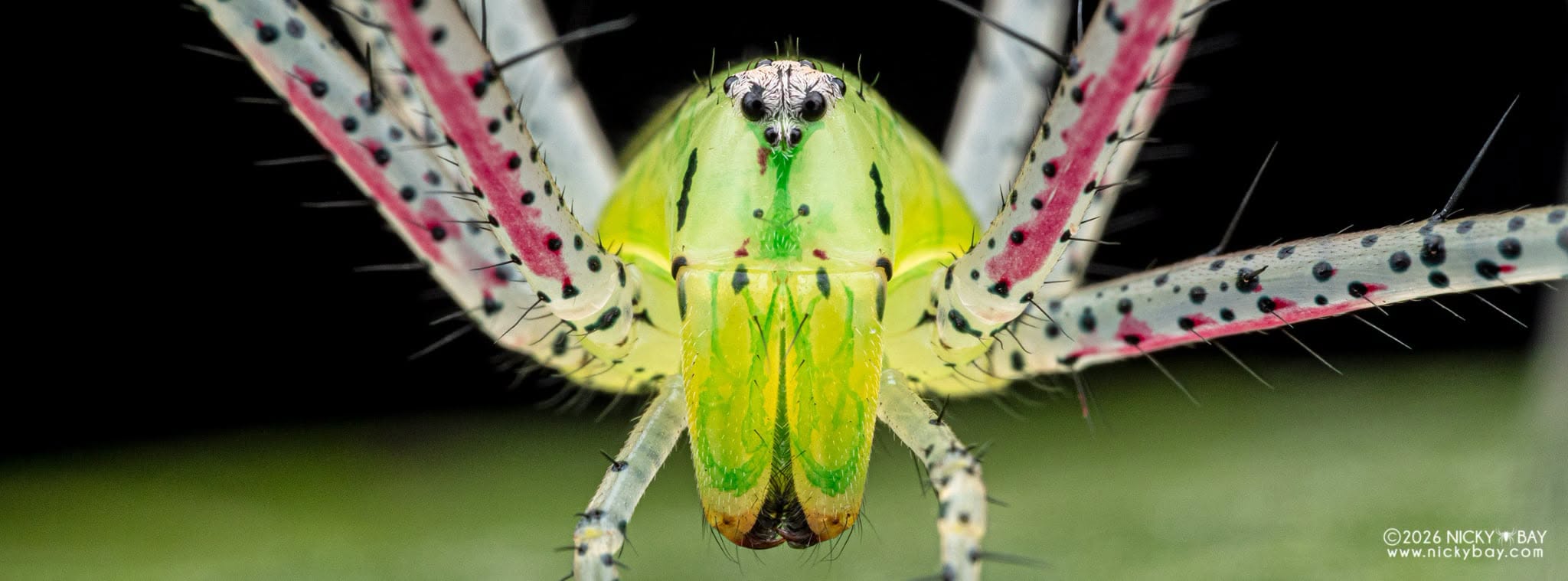
The AUGUST Spider of the Month (SOTM) is this green lynx spider (Peucetia sp.; Oxyopidae), photographed by Nicky Bay in Lunda Sul, Angola.
About the find, Nicky said the following:
“This was the last find at campsite 3 of our biodiversity survey in the highlands of Angola. Just as we were retiring for the night, I went back to the research tents to get the batteries charged and Rob found this Peucetia running around. This is probably the largest genus of oxyopids and I was quite certain that it fluoresced under ultraviolet. This combination allowed for pretty cool UV-induced fluorescence shots!
Olympus EM10 Mark IV, Laowa 50mm 2:1, and Godox MF12 twin flashes triggered by Godox X3, handheld. Flashes on custom 3D-printed mounts, with DIY diffuser. UV shots with same setup except a different 3D-printed mount and modified MF12 flashes.
Thank you to the sponsors and organisers from The Wilderness Project for making this expedition possible.”
Like nursery-web spiders (Pisauridae), even though they are all free-living hunters that don’t spin capture webs, green lynx spiders also deposit their egg sac in a special web (nursery web), where their babies will stay until they’re ready to disperse. The mother will also guard over the egg sac and babies, and some species have been observed to spit venom at any threats, up to 30 cm far. One person who was spat in the eye reported blurry vision and irritation in the eye.
As the common name suggests, they are mostly green, but they can also change to a brown/fawn colour to match dry vegetation, especially in more arid areas like the Northern Cape and Namibia. Some have even been spotted among the dunes in Namibia, living on tiny shrubs.
These spiders are very agile hunters and have been observed to jump into the air to catch insects mid-flight. They also pounce on their prey from above. This catlike hunting behaviour gave rise to their common name, lynx spiders.
There are 47 recorded Peucetia species in the world, most of which seem to occur in India. South Africa has nine recorded species; I’m not sure how many Angola has, but the World Spider Catalog lists four. Still, Angola’s spiders are poorly studied and there may be many more. I suspect that this is Peucetia striata, which also occurs in South Africa.
This is Nicky’s fifth SOTM, all won this year, and all from his expedition to Angola. Out of 194 people who voted, his photo received 112 (58%) votes. Congratulations, Nicky, once again, and thanks to everyone who voted!