
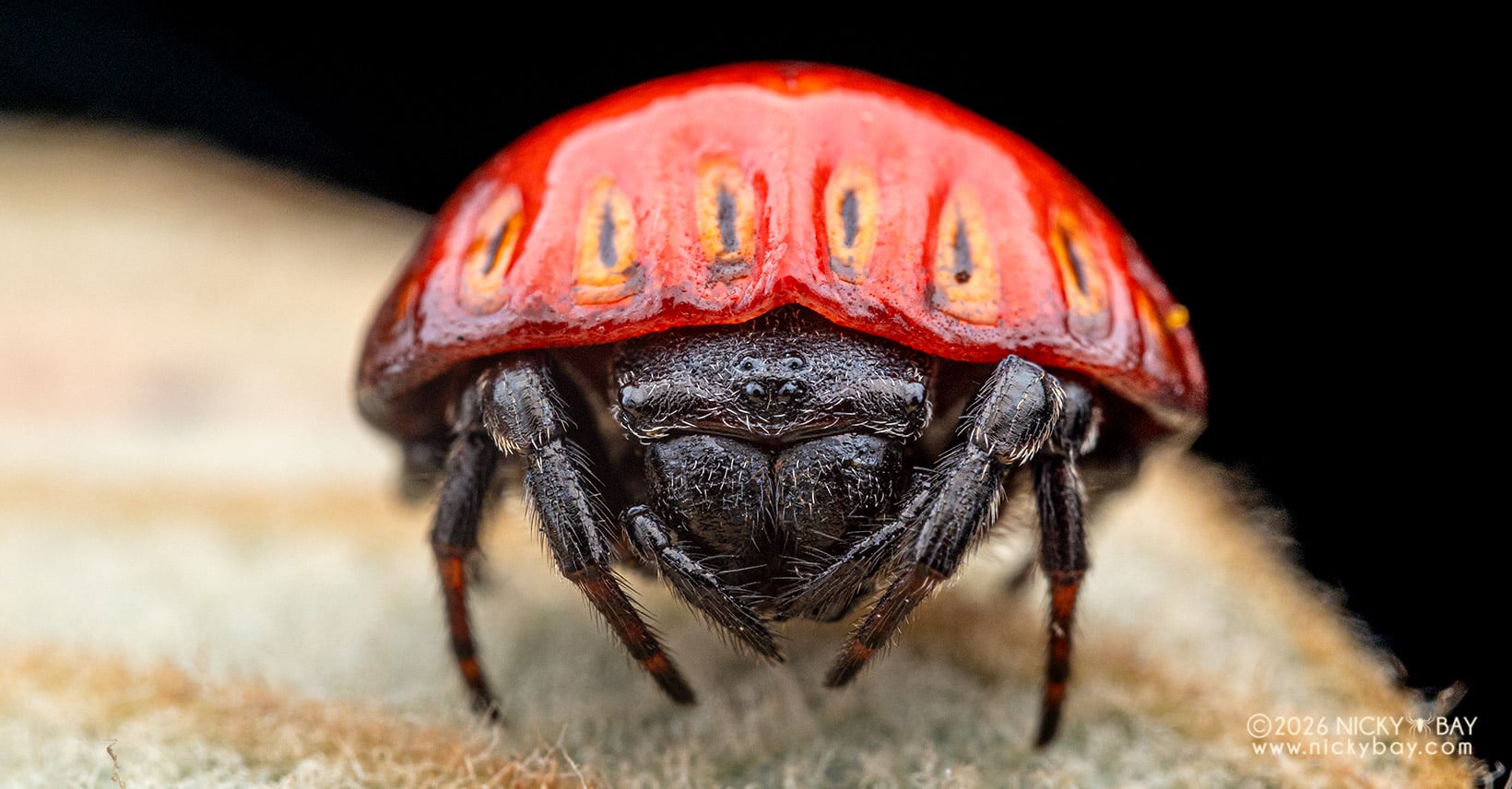
The March Spider of the Month (SOTM) is this Koch’s tortoise orb-web spider (Isoxya kochi; Araneidae), photographed by Nicky Bay in Lunda Sul in Angola.
Nicky said the following about this photo:
“This gorgeous spider was discovered by Rob Taylor in a swamp forest during a biodiversity survey in the highlands of eastern Angola organised by The Wilderness Project. This spider appears to mimic ladybird beetles, which taste repulsive to predators. Mimicking their shape and colour is a form of Batesian mimicry to deter predators that may want to avoid an unpalatable meal. I photographed this spider using an Olympus EM10 Mark IV, Laowa 50mm 2:1, and Godox MF12 twin flashes triggered by Godox X3. Flashes on custom 3D-printed mounts, with DIY diffuser.”
We normally call the Isoxya species “box kite spiders” but this species does not have the normal “box kite” shape and rather resembles the ladybird beetle shape of Paraplectana species, which we initially thought this was. Nicky wasn’t convinced because of the shape of the carapace. Incidentally, this species was initially described as Paraplectana kochi (O. Pickard-Cambridge, 1877), and was wrongly mislabelled as being from Australia. It clearly confused taxonomists as well, as this species was moved from Paraplectana to Isoxia to Gasteracantha to Paraplectanoides to Plectana to Gasteracantha again, and then finally to Isoxya. The last change was made by Hormiga et al. (2023).
Isoxya was initially described and named by Eugène Simon in 1885 as Isacantha, meaning “equal spines”. It was later renamed Isoxya. Both names originate from the Greek words iso (equal) and oxya/acantha (thorn/spine). This indicates how oddly shaped this spider is for Isoxya, since it has no spines. The shape of the carapace, however, is identical to other Isoxya species.
There are 17 Isoxya species in the world, all found only in Africa (and Madagascar). Six species are recorded from Southern Africa. I. kochi is listed as being from West, Central, and East Africa. Although Angola is sometimes considered part of Central Africa due to its climate, it is primarily considered a part of Southern Africa. This might then be the first record of this species in Southern Africa.
This is Nicky’s first SOTM. He is from Singapore and therefore doesn’t often post Southern African spiders to the group. A few years ago, he also visited Mozambique and Madagascar and posted some of those spiders here.
Of the 201 people who voted, this photo received a whopping 146 (73%) votes. Congratulations, Nicky, and thank you for posting your awesome photos to the group! Keep them coming!