
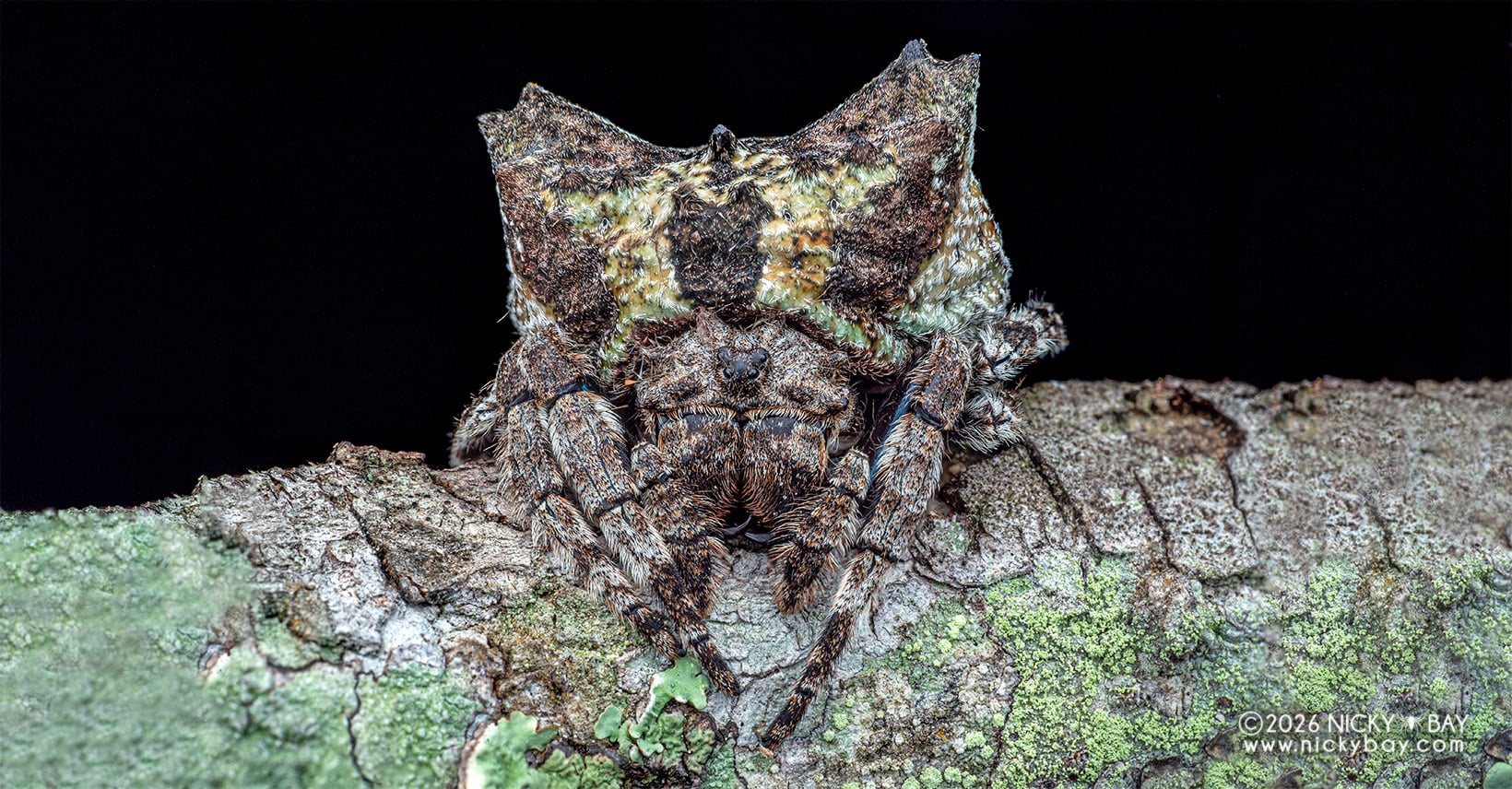
The April Spider of the Month (SOTM) is this bark spider (Caerostris sp.; Araneidae), photographed by Nicky Bay in Lunda Sul, Angola.
Regarding this find, during The Wilderness Project in Angola, Nicky said the following:
“At our first campsite, we made a path toward the swamp forest nearby and noticed a large Caerostris hanging out next to the path at night. Each night, a downpour would destroy her web, and she would simply rebuild her gigantic web (2-3 metres wide) again in the vicinity. On our last night at this site, she nonchalantly built her web across the path, forcing everyone to skirt around Her Majesty’s home. This is a really skittish individual that would drop into the bushes whenever I approached. I’ve lost her on the first two nights after each freefall but managed to find her and pick her up with a small branch to get some close-ups.
Olympus EM10 Mark IV, Laowa 50mm 2:1, and Godox MF12 twin flashes triggered by Godox X3. Stack of 5 shots, handheld. Flashes on custom 3D-printed mounts, with DIY diffuser.”
This is probably a horned bark spider (C. sexcuspidata) but bark spiders can vary quite a bit and Angola’s spiders are quite poorly studied, so it might be a different or unknown species. For example, C. sexcuspidata usually has two “horns”, but sometimes it has one horn, three horns, or a “crown of horns”. These horns can also vary in shape and size. No matter the variation, these spiders are excellently camouflaged on the bark of a tree, where they hide during the day when they’re not in their web. While these spiders are mostly nocturnal, in dark forested areas they are often found in their webs during the daytime.
There are 20 Caerostris species in the world, with four recorded species in South Africa. They are mostly found in Africa, with only two species found outside Africa. Ten species are found only in Madagascar, including Darwin’s bark spider (C. darwini), which is known to spin the largest web in the world, with bridge lines up to 25 metres long often spanning rivers.
The genus name Caerostris (described by Swedish arachnologist Tamerlan Teodor Thorell in 1868) most likely originates from the Greek word Kairo, meaning “knot”, referring to their resemblance to tree knots, or the Latin words Caera and ostrum (“shell”). The specific epithet “sexcuspidata” means “six-pointed”.
Out of 206 people who voted, this photo received 105 (51%) votes. Nicky’s Smodicinus coroniger photo was behind with only five votes. This is Nicky’s second SOTM. If two more people had voted for his Chrysso photo, he would have had all five of his photos in the Top 5, which would have been a first in SOTM history. Congratulations, Nicky! Keep the awesome shots coming, and when you run out, come visit us in South Africa to take more!